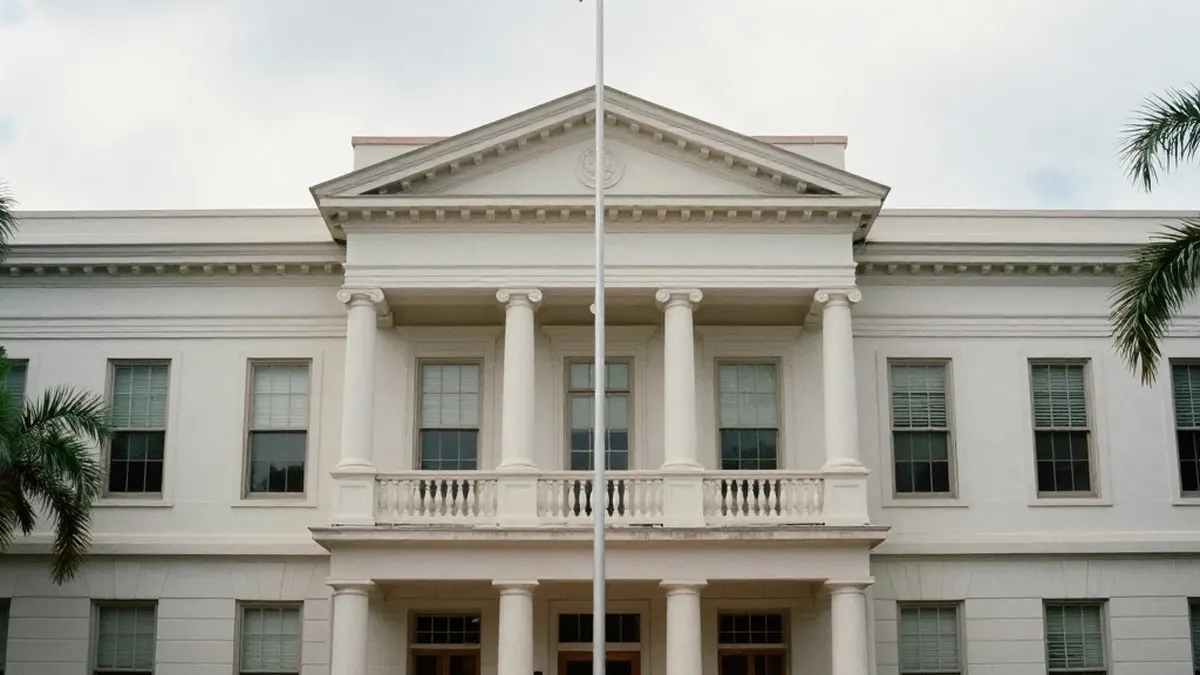
Poland: President Storms Constitutional Court After Judges Suspend Rivals
A physical confrontation outside the building marked the latest escalation in a decade-long legal battle over the court's composition.
By Sarah Ross ·
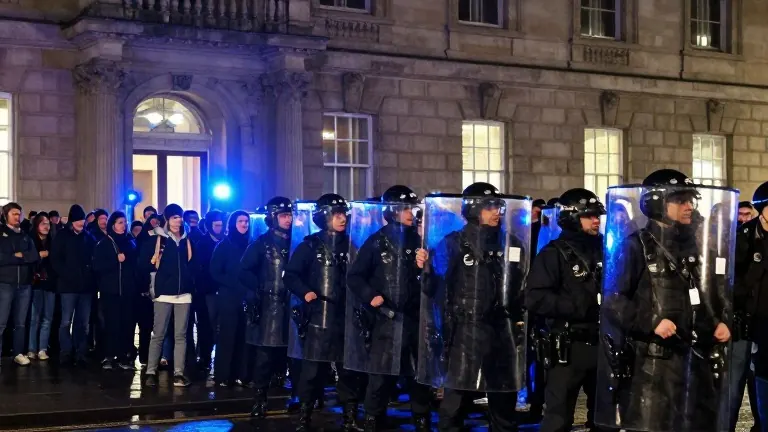
Hundreds of protesters gathered outside the Polish constitutional court on Friday night, a number that swelled as tensions rose following the sudden suspension of the court's top judge. The standoff ended with President Karol Nawrocki physically pushing through police lines to enter the building, a move that has intensified a decade-long dispute over the institution's legal status.
The crisis began when a group of government-aligned judges voted to suspend Bogdan Święczkowski, the court's president, and his deputy, Bartłomiej Sochański. The decision was taken amid ongoing disagreements about which judges hold legitimate seats on the bench. The move triggered an immediate and fierce reaction from the right-wing opposition, the Law and Justice party, whose leader Jarosław Kaczyński described the action as an assault on the court.
Nawrocki, who is a close ally of Donald Trump, was originally en route to Senegal for a state visit. He turned his plane around to return to Warsaw and intervene directly. Shortly before 1:00 a.m. on Saturday, the president appeared at the scene. Video footage captured him struggling with security personnel and other judges to force his way inside. By 4:00 a.m. local time, he remained within the building.
In a clip released online, Nawrocki stated that the government appointees were not judges of the constitutional court. Later, at 5:00 a.m., a statement read on his behalf accused the government of violating Poland's constitutional order. The statement claimed that a constitutional body had been seized by force and demanded that security forces leave the premises.
Three people were arrested during the night for attempting to force entry through a heavy police presence. The suspended judges included Anna Korwin-Piotrowska, one of five judges elected by the current parliament but not sworn in by Nawrocki. She cited her extensive judicial experience to assume the top position after the suspension vote.
The legal status of the suspension is a point of deep division among experts. Marcin Matczak, a law professor and critic of the opposition, said he believed the legal basis for suspending Święczkowski was non-existent. Justice Minister Waldemar Żurek announced that he had requested the removal of legal immunity for Święczkowski and Sochański to allow for prosecution related to obstructing the court.
The conflict traces back to 2015, when competing governments attempted to stack the bench with their own appointees. Since returning to power in 2023, Prime Minister Donald Tusk has sought to reverse reforms and mend relations with the European Union. He has refused to recognize the court's legitimacy in its current form, though his efforts have often been blocked by presidential vetoes.
This year, Nawrocki refused to swear in five judges elected by the current parliament. The Venice Commission, an advisory body of the Council of Europe, stated earlier this month that this refusal should not prevent those judges from taking their posts. Tusk maintained that restoring the rule of law is a duty, noting that the process is difficult but requires decisive action.
Foreign Minister Radosław Sikorski told reporters in Atlanta that the court was politicized under the previous government. He said the current actions aim to allow the majority of duly elected judges to make the tribunal function again. Opposition leaders and several European far-right figures, including Nigel Farage and Geert Wilders, condemned the move as a judicial coup.
The U.S. ambassador to Poland, Tom Rose, posted on X that the events were very serious. He noted that both sides offer sharply different accounts of what happened. Rose warned that the large crowd outside the tribunal made the situation more combustible, stating that Poland did not need a confrontation that spiraled out of control.
Source: The Guardian