
Ukrainian firm tests AI drones in Kyiv
A defense startup uses autonomous technology to guide small drones to their targets during the final stretch of flight.
By Sarah Ross ·
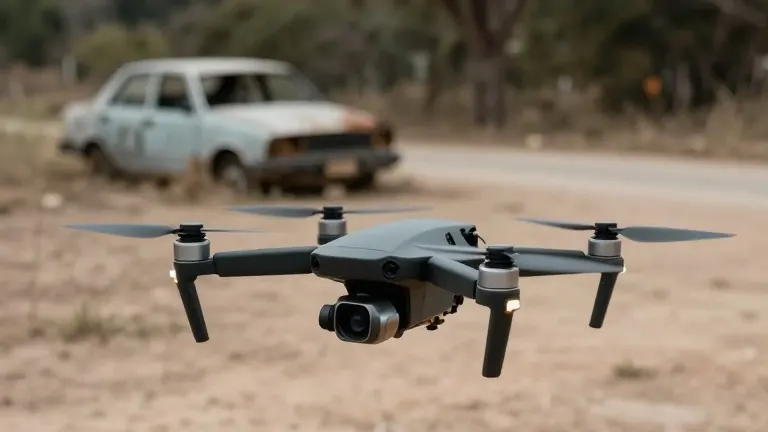
Yaroslav Azhnyuk runs The Fourth Law, a Ukrainian defense firm that builds autonomous drones for the military. He previously worked in Silicon Valley, where he co-founded Petcube, a company that sold one million AI-powered pet cameras. After Russia launched its full-scale invasion in 2022, Azhnyuk shifted his focus from consumer tech to warfare. He now leads The Fourth Law and another company, Odd Systems. Both are among the top producers of AI-enabled drones in Ukraine. Dozens of military units have already deployed the firm’s main product, the Lupynis-10-TFL-1.
The drone combines a small, affordable first-person-view airframe with an onboard computer. A pilot guides the craft for most of the flight. During the last 500 meters, or 0.3 miles, the AI takes over. The system uses a deep-learning neural network trained on hours of combat footage. It recognizes vehicles, tanks, and flying objects. Azhnyuk describes the technology as distinct from the large data center models that power chatbots or self-driving cars. He calls it a simple image recognition tool that allows the drone to navigate and select targets without human input.
The company named its drone after Anatoliy Lupynis, a 20th-century Ukrainian poet and activist who survived Soviet imprisonment. The Fourth Law names its weapons after Ukrainian intellectuals killed or persecuted by Russians. Azhnyuk says honoring these figures helps resurrect their ideas. He notes that the technology provides an asymmetric advantage. He claims it can make a unit 10,000 times more effective against an enemy with superior capabilities.
In a field outside Kyiv, a test team demonstrated the drone’s capabilities. A pilot controlled the aircraft with a stick until he locked onto a target. The target was a dilapidated car driven by an employee. Once the system locked on, the pilot released the controls. The drone flew itself to the vehicle. The microcomputer inside the drone ran algorithms to maintain its course. The test drone carried no explosive, but the system is designed to hit moving targets on the battlefield.
Azhnyuk addresses concerns about AI ethics. He argues that the fear of destructive tools is not unique to artificial intelligence. He compares the technology to fire and steel, noting that humans decide how to use any tool. He insists that current safeguards prevent the drones from going rogue. Humans select the targets, and the AI executes the approach. He acknowledges that AI is developing quickly. He does not rule out the possibility of drones making their own target decisions in the future.
President Volodymyr Zelenskyy has warned that AI could lead battlefield decisions as soon as next year. Russia is also deploying AI-enabled drones. Azhnyuk says Ukraine must match its adversary’s technology. If the enemy uses AI for offensive decision-making, Ukraine needs AI for defense. He points out that AI systems make decisions in microseconds, while human control takes minutes or hours. He concludes that if Ukraine loses the war, there will be no time to debate the ethics of AI.
The Fourth Law tests its drones daily. The team operates from a secure location near Kyiv. They aim to improve the speed and accuracy of the autonomous guidance system. The firm continues to integrate thermal cameras and AI software into its hardware. Azhnyuk remains focused on the immediate needs of the battlefield.
Source: WUFT
More Business · Rip-Off Report · Report a business · Got a Story?