Israel votes between two right-wing coalitions
Voters decide on a government defined by a rightward shift, with no mainstream candidate offering a distinct policy break on Gaza or the West Bank.
By Rahul Garnier ·
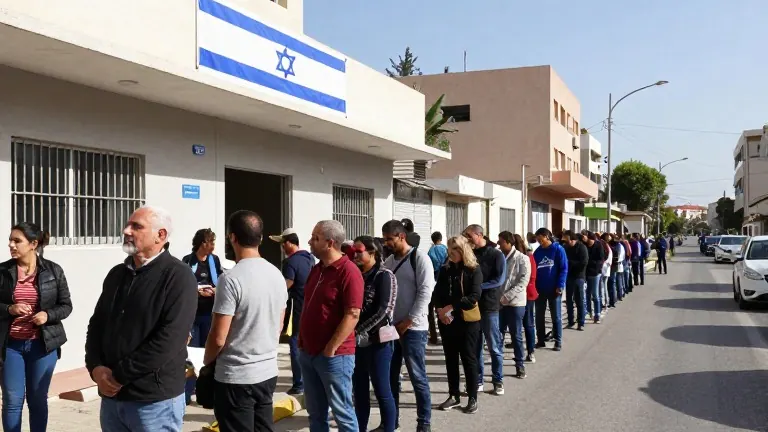
Israelis went to the polls on Tuesday to hold the first general election since the Hamas-led attack of October 7, 2023. The vote determines whether Prime Minister Benjamin Netanyahu will serve a fourth term or if a self-styled Zionist opposition bloc will take power. Both major camps have adopted a right-wing approach to Israel's security and social challenges, leaving voters with a choice between coalitions rather than a clear ideological split.
Netanyahu, the country's longest-serving prime minister, leads the governing coalition that united far-right ultranationalists and ultra-Orthodox parties. He faces a corruption trial and an International Criminal Court warrant for war crimes in Gaza. His challengers argue he is too divisive and that his tenure has eroded democratic norms, but they have not presented a fundamentally different vision for the country's relationship with Palestinians.
The political landscape has shifted sharply to the right since the 2023 attack. Analysts note that the erosion of the center and left began earlier, marked by the 2018 Nation-State Law and the expansion of settlements in the occupied West Bank. The current government accelerated this drift by attempting to strip the Supreme Court of its power to review government actions. It also flouted rulings on conscripting ultra-Orthodox men, a move supported by key coalition partners.
National Security Minister Itamar Ben-Gvir and Finance Minister Bezalel Smotrich provided crucial support for Netanyahu's judicial overhaul. In return, they received cover for the surge in violence in the West Bank. The coalition also deflected questions about security failures that preceded the 2023 attack. Despite a declared ceasefire, deadly attacks continue almost daily in Gaza, and settler violence has intensified in the West Bank.
Yehouda Shenhav-Shahrabani, an Israeli sociologist, described the political system as operating within a framework of Jewish supremacy. He stated that no alternative leaders can be genuinely described as left-wing. "The horrifying reality we are witnessing is not simply the product of Netanyahu or the far right. It is rooted in Zionist political thought itself, which is structured around the principle of Jewish supremacy," Shenhav-Shahrabani said.
Ahron Bregman, a senior teaching fellow at King's College London, said the main initial change if the opposition wins would be the atmosphere. He noted that Netanyahu is a deeply divisive figure who is viewed with extreme admiration or hatred. "He’s a very divisive figure. A new prime minister is likely to calm things down," Bregman said. However, he cautioned that any new government would still reflect the sharp rightward turn of Israeli society.
Yossi Mekelberg, a senior fellow at Chatham House, framed the election as a choice between a functioning democracy and one in name only. He also described it as a decision on whether to maintain the occupation of the West Bank or annex it entirely. He cited government suggestions of population "voluntary migration" from the territory as evidence of this direction.
More than 74,000 people have been killed in Gaza, according to figures cited by analysts. The election campaign largely excluded questions about this death toll and the treatment of Palestinians in the territories. None of the mainstream candidates discussed including Arab-led parties in a potential coalition. Leaders of Ra’am and the Joint List are often used by rivals to denounce each other for past or potential cooperation with Palestinian politicians.
Daniel Levy, a former Israeli government adviser, said the election is not a referendum on the war in Gaza. "You would have to have one side arguing it was a good thing and the other arguing it was a bad thing, let alone acknowledging that it was a genocide. So, no, obviously none of that is on the ballot," Levy said. He added that the treatment of Palestinians is a consensus among Zionist parties, with differences resting on whether the state or settler militias should play a primary role.
Shenhav-Shahrabani noted that ultra-Orthodox parties remain welcome in government under either coalition, while Arab-led parties representing one-fifth of the population are excluded. He argued that the distinction in politics is not between democratic and anti-democratic forces, but between Jews and Palestinians. The result of the Tuesday vote will determine the composition of the next Knesset and the direction of the coalition government.
Source: Al Jazeera