13% Drop: College Freshman Supply Shrinks as Admissions Offices Pivot to Friendliness
With enrollment targets at risk, institutions are waiving fees and inviting faculty into the recruiting process to capture a shrinking pool of applicants.
By Rahul Garnier ·
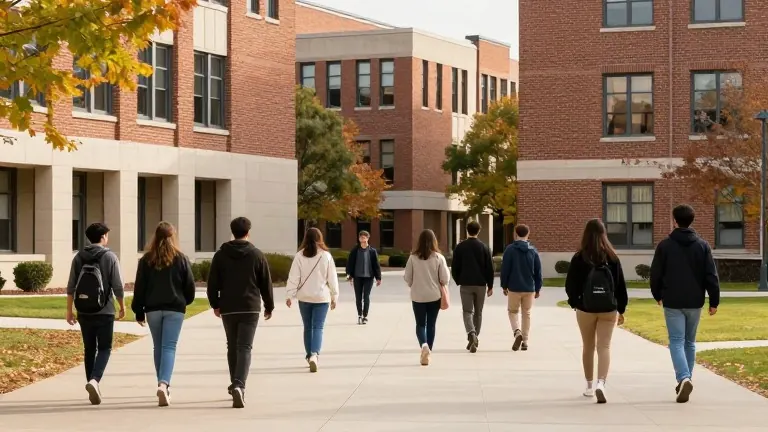
The supply of traditional-age freshmen in the United States is projected to decline by 13 percent over the next 15 years, according to the Western Interstate Commission for Higher Education. This demographic shift has forced colleges to rethink how they recruit students, moving away from secretive processes toward a more open and welcoming approach to retain applicants.
The pressure on institutions is visible in their operations. Two-thirds of admissions leaders reported difficulty meeting enrollment targets in at least one of the last two years, based on a survey by the ratings platform Niche. To compete, schools are waiving application fees and offering financial incentives for campus tours. In 17 states, public universities now admit high school students who have not formally applied. More than 150 private colleges make direct offers to students who submit the Common App, a standardized online application used by roughly 1,200 institutions.
Skidmore College in Saratoga Springs, New York, has taken a specific step by enlisting faculty to meet with prospective and admitted applicants. Previously, this role was handled entirely by the admissions office. Jess Ricker, the college's vice president for enrollment, stated that this strategy helps students feel valued and distinguishes the school from competitors. At Washington College in Maryland, faculty sit down with visitors on designated Fridays during the admissions season. Johnnie Johnson, the college's vice president for enrollment management, noted that some faculty initially resisted, but financial realities have changed their minds.
"When you put a financial figure on every student who comes in, that equates to programmatic funding. That equates to raises," Johnson said. He added that faculty see colleagues at other institutions facing closures or program cuts, which motivates them to participate in recruiting efforts.
The ease of admission has increased even as student perceptions suggest the opposite. Nearly 8 in 10 first-year applicants to public colleges and 7 in 10 to private institutions are accepted, according to the National Association for College Admission Counseling. These rates have risen from 68 percent and 65 percent, respectively, a decade ago. However, a Pew Research Center survey found that more than 40 percent of adults aged 18 to 29 believe getting into college is harder now than for their parents' generation. Angel Pérez, the CEO of NACAC, attributed this misconception to the high profile of elite institutions like Harvard and Stanford, which accept about 1 in 25 applicants.
Colleges face another challenge in predicting how many admitted students will actually enroll. This metric, known as yield, has dropped from 32 percent in 2014 to 22 percent in 2024 at public institutions. At private, nonprofit colleges, the rate fell from 24 percent to 18 percent over the same period. Students are applying to more schools, with Common App users averaging more than seven applications. This behavior makes it difficult for enrollment managers to forecast final numbers, requiring colleges to admit more students than they can seat to ensure they fill their classes.
At Skidmore, which has 2,719 students, more than three-quarters of admitted visitors requested to sit in on a class or meet with a faculty member last year. These interactions totaled 300 personal visits. Becca Johnson, the Psychology Department Chair, reported receiving positive feedback from families. One mother told her that the faculty contact was the first from outside the admissions office and was meaningful in their decision-making process.
The college expects to continue these efforts as it faces the same headwinds as other institutions. Marc Conner, the president of Skidmore, said the school is encouraging everyone from dining hall workers to groundskeepers to be welcoming. He noted that the community understands the institution's future depends on how much everyone joins together to support the student body.
Source: WUWF