UCF Scientist Wins $175,000 to Study 25-Spacecraft Telescope Concept
Anish Roshi Damodaran was selected for NASA's Phase I NIAC program to develop the PHOENIX interferometer.
By Rahul Garnier ·
University of Central Florida professor Anish Roshi Damodaran has received a $175,000 grant from NASA to investigate a new space telescope design. The funding comes from the agency's 2026 Innovative Advanced Concepts program, which selected 18 researchers for its first phase of study.
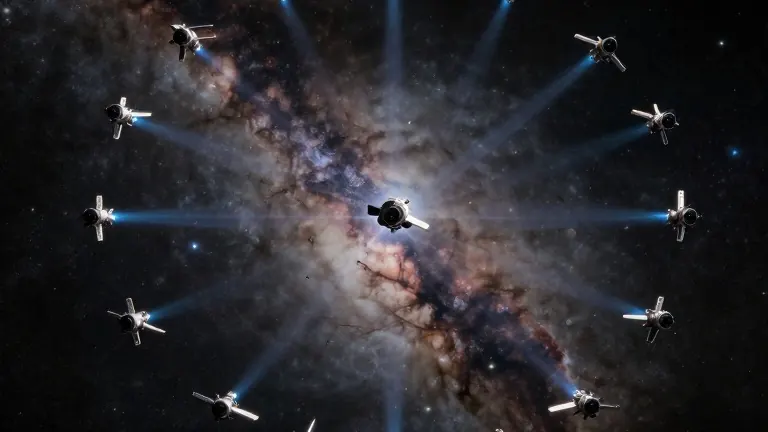
Damodaran leads the project, known as PHOENIX, which stands for Photonics-Enabled Heterodyne Submillimeter/Far-Infrared Interferometer. The concept proposes linking up to 25 individual spacecraft using advanced photonic technologies. Working in concert, these satellites would act as a single, massive virtual telescope. This setup aims to produce high-resolution images at submillimeter and far-infrared wavelengths.
The UCF professor previously directed radio astronomy at the Arecibo Observatory. He returned to UCF after the telescope's collapse in 2020. His current team includes partners from UCF's College of Optics and Photonics, the Florida Space Institute, and the Department of Physics. NASA's Jet Propulsion Laboratory also contributes researchers to the effort.
Existing observatories struggle to resolve fine structures in cold gas and dust associated with planet and star formation. A single large telescope faces launch limitations, while multiple smaller satellites require precise synchronization and massive data processing. Damodaran states that current facilities can detect these materials but cannot directly resolve the critical structures where these processes occur.
The nine-month Phase I study will not build the observatory. Instead, the team will refine the mission architecture and identify necessary enabling technologies. They will also assess performance requirements and technology readiness. Damodaran described the work as similar to a second Ph.D. thesis, requiring the questioning of assumptions and the exploration of alternative approaches.
Following his selection, Damodaran attended a NIAC orientation symposium to meet other fellows. The program offers further funding opportunities for promising concepts. Phase II awards provide up to $750,000 for two years of development, while Phase III awards offer up to $2 million for another two years.
NASA plans to select six to eight projects for Phase II and one for Phase III each year. The PHOENIX team will now work to define the scientific capabilities of the concept and prepare a roadmap for continued development.
Source: UCF Today