Magnetic tiles scheduled for ISS test to form first large self-assembled structure
A new batch of magnetic tiles will attempt to form a ball-shaped structure in orbit, marking a step toward scalable space habitats that eliminate the need for manual assembly.
By Katherine Diallo ·
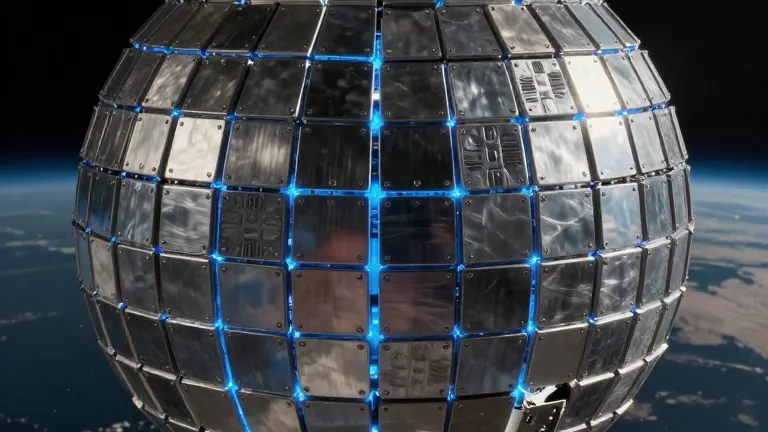
A new test of self-assembling magnetic tiles is scheduled for the International Space Station in December or January. The experiment aims to prove that modular components can construct large structures in orbit without human intervention. This approach offers an alternative to the labor-intensive methods used to build previous space infrastructure. The technology could reduce the cost and complexity of creating living and working spaces off Earth.
The system, known as TESSERAE, was invented by Ariel Ekblaw during her doctoral studies at the Massachusetts Institute of Technology. The tiles use electro-permanent magnets, cameras, and artificial intelligence to identify and attach to one another in a predetermined configuration. Ekblaw, now the founder of the Aurelia Institute, stated that the tiles can assemble into structures much larger than the rocket that delivered them. She described the potential for building large, grand structures in space.
Historically, space construction has relied on multiple missions and manual labor. The International Space Station required dozens of flights and robotic arms to assemble. In recent years, other companies have tested inflatable habitats. Bigelow Aerospace attached an inflatable module to the station in 2016. Sierra Space is currently testing a three-story inflatable habitat, and Max Space unveiled expandable modules earlier this year. Saleem Miyan, co-founder of Max Space, noted the need for scalable real estate for human operations off Earth.
Researchers are also exploring ways to reduce the need for transporting materials from Earth. Scientists at the European Space Agency have experimented with bricks made from meteorite dust. China is investigating the use of lunar soil for construction. Sandra Häuplik-Meusburger, a space researcher at the Vienna University of Technology, pointed out challenges in protecting humans from radiation and designing long-term living spaces. She suggested that adaptable architecture allows structures to be repurposed over time.
The reconfigurability of the magnetic tiles is a central feature of the design. Ekblaw explained that users can remove specific tiles and add new ones to change the shape of the structure. This flexibility applies to various potential uses beyond habitats. Startups are considering data centers and solar farms in space to utilize constant sunlight. Häuplik-Meusburger described the current activity in the sector as a gold rush with interest from many different players.
Small-scale versions of the tiles were tested aboard the space station in 2020 and 2022. Those initial tiles were only a few inches wide. The upcoming test involves larger tiles equipped with cameras on their edges to facilitate autonomous assembly. If the test succeeds, the tiles will form a ball-shaped structure approximately the size of a giant beach ball. This will be the first time the system creates a spherical shape.
Rendezvous Robotics, a spinoff from the Aurelia Institute, will handle the next phase of development. The company announced on October 28 that it raised $20 million in funding. The tiles currently under development range from one to three feet in width and use electromagnets. The company plans to conduct its first demonstration in 2028 outside the space station. That test will involve tiles self-assembling into a flat shape in the vacuum of space.
Ekblaw, who serves as co-founder and board chair of Rendezvous Robotics, identified large antennas and solar arrays as the first realistic applications for the technology. She suggested the system could also support future AI data center buildouts in space. The technology is designed to handle any large-scale infrastructure needs in the orbital environment.
Source: CNN