Spain's rail death toll climbs to 69 after second crash this year
Rescue teams continue searching for survivors in central Spain as officials investigate a signaling failure that caused the collision.
By Sarah Ross ·
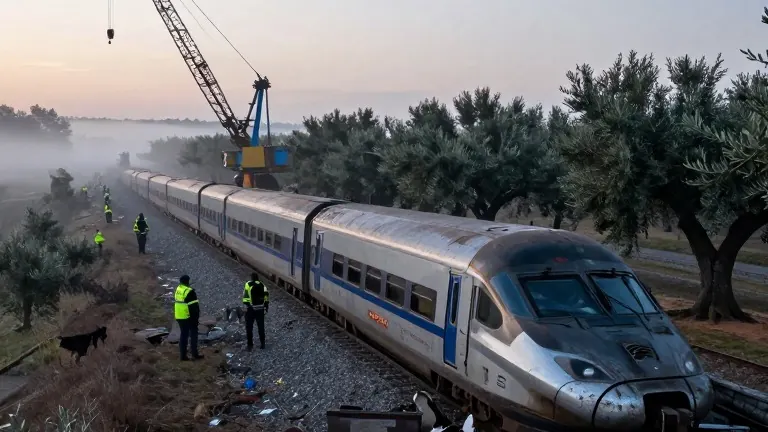
Sixty-nine people are confirmed dead after a high-speed train collision in central Spain, according to regional leader Emiliano García-Page. Officials described the toll as provisional, noting that one additional body was recovered overnight. The crash occurred on Wednesday morning, marking the second fatal high-speed rail disaster in Spain this year.
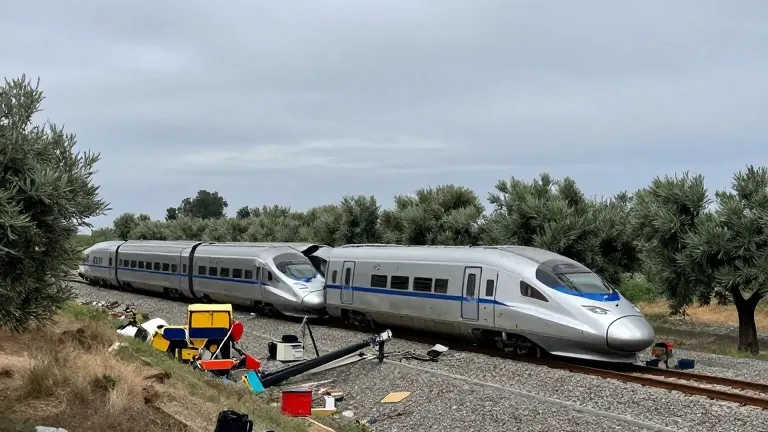
Search operations continued on Thursday morning with sniffer dogs and cranes. Police and soldiers worked to shift carriages and pick through debris scattered down a gravel slope. At least three train carriages were thrown from the tracks by the impact. García-Page said 50 people remained hospitalized and that identification work was ongoing due to the fragmentation of remains.
Spain's government declared three days of mourning starting Thursday. The Global Affairs Canada ministry reported that six Canadian citizens were injured in the crash, while a seventh remains unaccounted for. The department stated it is providing consular assistance and coordinating with local authorities to determine the severity of injuries.
Transport Minister Óscar Puente attributed the crash to a specific sequence of events. A computer malfunction stopped the security system on a 63-kilometer stretch of track at 8:30 a.m. local time. All trains halted, leaving an IRYO train stopped near the town of Urda. A RENFE train was positioned 25 kilometers behind it. Minutes later, the central command center ordered the RENFE train to resume motion without speed restrictions. The moving train struck the stationary IRYO train at 8:53 a.m. Puente called the order inexplicable because a stop signal was still active.
Both this crash and the January incident that killed 46 people occurred on the same rail line connecting Madrid and Seville. Each involved trains operated by state-owned RENFE and privately owned IRYO. The high-speed line was shut down, stranding thousands of travelers. Spain's network is the world's second-largest after China's and had avoided deadly crashes since launching more than three decades ago until January.
The accident has intensified political scrutiny ahead of a national election on November 29. Prime Minister Pedro Sánchez visited the site in Toledo province on Wednesday. He pledged an investigation and safety improvements, stating that two accidents in one year is not acceptable. His rival, People's Party leader Alberto Núñez Feijóo, demanded a full inquiry and cancelled his party's campaign events for the day.
Far-right Vox leader Santiago Abascal used the crash to criticize the current administration. He vowed to work until the government answers for the incident in court. The collision adds rail safety to a list of issues including housing costs and migration policy that voters will consider in weeks.
Source: CBC News